
Battery or Alternator? How to Tell What's Really Wrong With Your Car
Date Posted:20 September 2026
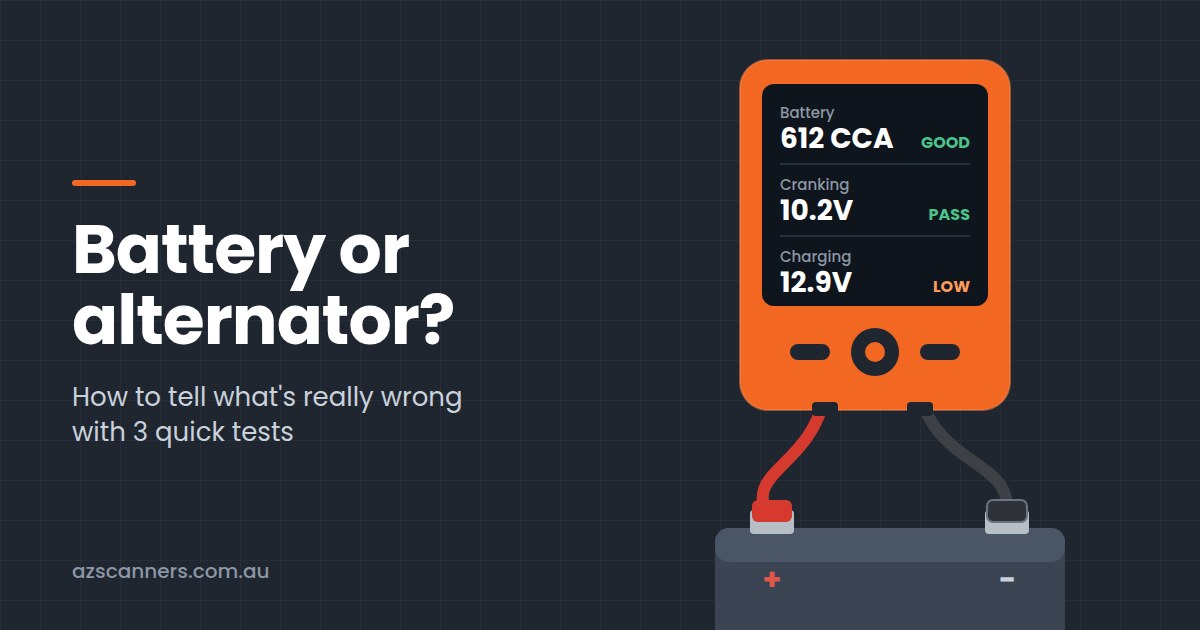
Your car clicks instead of starting, or it starts after a jump and is flat again the next morning. The obvious move is to buy a new battery. But if the real problem is the alternator, the new battery will be flat within a week too, and you've spent $250 or more for nothing.
Flat batteries are the number one cause of breakdowns in Australia. A good share of the "dead batteries" replaced every year weren't actually the problem. This guide shows you how to find the real cause in about five minutes. It covers the symptoms, the voltage numbers, and the three tests workshops use.
Quick answer: If the car won't start but runs fine after a jump start, the battery is the likely culprit. If the car dies while driving, the battery warning light comes on, or the lights dim and brighten with engine revs, suspect the alternator. If both test fine but the battery keeps going flat overnight, you have a parasitic drain. A battery tester that runs battery, cranking and charging tests will tell you which it is in about a minute.
Battery vs Alternator: The Symptoms
| Symptom | Most likely cause |
|---|---|
| Clicking or slow crank, car starts after a jump and keeps running | Battery |
| Car starts after a jump but stalls soon after | Alternator |
| Battery/charging warning light on while driving | Alternator (or its belt) |
| Headlights dim at idle and brighten when you rev | Alternator |
| Whining or grinding noise from the front of the engine | Alternator bearings |
| Burning rubber or hot electrical smell | Alternator or slipping belt |
| Fine all week, flat after sitting a few days | Parasitic drain or ageing battery |
| Swollen case, leaking, or heavy terminal corrosion | Battery |
| Battery 4+ years old and struggling on cold mornings | Battery |
Symptoms narrow down the suspects, but they don't prove anything. For that you need numbers.
Why a Voltage Reading Alone Can Fool You
Many people check their battery with a multimeter, see 12.6V, and decide the battery is fine. Voltage only tells you the state of charge, meaning how full the battery is. It doesn't tell you the state of health, meaning whether the battery can still deliver the current needed to crank an engine.
A battery with badly sulphated or corroded plates can show a perfect 12.6V at rest. It still collapses the moment the starter motor asks for 400 amps. Think of it like a fuel gauge reading full on a tank with a blocked fuel line.
There's also surface charge to watch for. Straight after driving or charging, a battery can read higher than its true level. For an honest resting voltage, wait a few hours. Or switch the headlights on for a minute, turn them off, then measure.
Resting voltage guide for a 12V lead-acid battery:
| Resting voltage | Approx. state of charge |
|---|---|
| 12.6V or higher | ~100% |
| 12.4V | ~75% |
| 12.2V | ~50% |
| 12.0V | ~25% |
| Below 11.9V | Flat |
To test health, you need a tester that measures CCA (Cold Cranking Amps) against the rating printed on the battery label. Modern conductance-based car battery testers do this in seconds, without heavy load plates or sparks.
The 3-Test Method Workshops Use
A good automotive battery tester runs three tests. Together they give you a clear answer.
Test 1: Battery test (engine off)
Connect red to positive and black to negative. Select the battery type (Flooded, AGM, EFB or Gel) and enter the CCA rating from the battery label. The tester compares the battery's actual cranking ability with its rating and gives a result such as Good, Good – Recharge, Charge & Retest or Replace.
- Choose the correct battery type. Testing an AGM battery on the "Flooded" setting gives misleading results. Stop-start vehicles almost always use AGM or EFB.
- Charge a flat battery before judging it. A deeply discharged battery can test badly even when it's healthy. If the tester says Charge & Retest, do exactly that.
Test 2: Cranking test
Start the engine while the tester is connected. It records how far the voltage drops during cranking. A healthy system should generally stay above about 9.6V. A deep drop below that points to a weak battery, a dragging starter motor, or poor cable connections.
Test 3: Charging test (engine running)
With the engine running, the tester measures alternator output. On a conventional charging system, expect roughly 13.8V–14.7V. Then turn on the headlights, blower fan and rear demister and test again under load. The voltage should hold up rather than sag towards battery voltage.
Better testers also check ripple voltage. Excessive AC ripple usually means a failed alternator diode. That's a fault that slowly drains the battery and upsets electronics, and a basic multimeter will miss it.
Reading the Results
| Battery test | Charging test | What it means |
|---|---|---|
| Replace | Normal | Battery is the problem. Replace it. |
| Good | Low / no output | Alternator (or belt/wiring) is the problem. A new battery won't fix it. |
| Replace | High (over ~15V) | Overcharging. A faulty regulator has probably cooked the battery. Fix the alternator before fitting a new battery. |
| Good | Normal, but the car keeps going flat | Parasitic drain (see below). |
| Good | Normal, but slow cranking | Check the starter motor, earth straps and cable connections. |
The third row is the costly one. People replace a battery that died from overcharging, leave the faulty alternator in place, and destroy the new battery within months.
The "Smart Alternator" Catch
Many modern vehicles, including a lot of late-model Fords, VW Group cars, Mazdas and most stop-start vehicles, use smart charging systems. The engine computer varies the alternator output to save fuel. It may charge at 12.5V while cruising and jump to 15V during deceleration.
A "low" reading at idle on these cars is not automatically a fault. Load the system with headlights, fan and demister and see whether the voltage rises to meet the demand. If you're unsure, check the vehicle's service data or use a scan tool that can read the charging system's live data.
The Third Suspect: Parasitic Drain
If both the battery and alternator test well but the car is flat after a few days, something is drawing current with the ignition off. Common causes include aftermarket dash cams, alarms, stereos, a glovebox or boot light that stays on, a stuck relay, or a module that never goes to sleep.
Once the car's modules have gone to sleep, which can take 20 to 60 minutes after locking, a typical modern vehicle draws only a small current. That's often around 50mA or less, but check the manufacturer's spec. To find a drain, measure the draw with an automotive multimeter or current clamp and pull fuses one at a time until the draw drops.
A Bluetooth battery monitor like the Autohil ABM2 is useful here too. It stays connected and logs voltage over days, so you can see exactly when the battery starts dropping. It's also well suited to caravans, boats and cars that sit for weeks.
Replaced the Battery and It's Still Playing Up?
On many European and stop-start vehicles, a new battery has to be registered with the car's battery management system. Without registration, the car keeps charging the new battery as if it were the old, worn one. That usually means overcharging, which shortens battery life and can cause stop-start faults and random warning lights.
If you drive a BMW, Mercedes, Audi, VW, Volvo, Land Rover or a recent Ford, check whether your vehicle needs this step. You'll need a battery registration scan tool to do it. Also make sure the replacement matches the original type. Don't replace an AGM battery with a standard flooded one.
Why Australian Batteries Die Younger
Most people assume cold weather kills batteries, but heat does the real damage. High under-bonnet temperatures speed up electrolyte loss and plate corrosion, which permanently reduces capacity. Cold weather simply reveals the damage: it cuts a battery's available output, so a battery that coped all summer suddenly fails on the first frosty morning in June.
Batteries in hotter parts of Australia, especially northern and inland regions, often don't last as long as those in milder climates. Testing your battery at the end of each summer, before winter arrives, is one of the easiest ways to avoid a surprise breakdown.
Which Battery Tester Do You Need?
Home mechanics and everyday drivers (12V cars)
For quick battery, cranking and charging tests at home, the Vident iBT100, iCarsoft BT900, AUTOOL BT360 and TOPDON BT100 are compact and easy to use. Each one costs less than a single wrong battery purchase.
Prefer your phone?
The Launch BST-360 is a Bluetooth tester for 6V and 12V batteries. It shows results on your phone, so it's handy for motorcycles as well as cars.
Utes, 4WDs, trucks and mixed fleets (12V and 24V)
The TOPDON BT200 and AUTOOL BT880 add 24V support. That covers light commercial and heavy vehicles as well as the family car.
Workshops and mobile mechanics
- TOPDON BT300P: built-in printer for instant customer reports, which makes it much easier to justify a battery sale to a customer.
- Autel MaxiBAS BT506: adaptive conductance testing, app connectivity, and integration with Autel diagnostic tablets.
- TOPDON BT600 Plus and Autel MaxiBAS BT608: full system testing with printers and the widest battery type coverage, suited to busy workshops.
Internal resistance testing
The ALLOSUN EM3610 measures internal resistance using a 4-wire, 1kHz AC method. It's useful for comparing batteries and cells precisely.
Useful extras when replacing a battery
A car battery memory saver keeps radio codes, settings and adaptations alive while the battery is disconnected. A smart battery charger lets you fully charge a battery before retesting it.
Browse the full battery tester range
FAQs
Can a bad alternator ruin a new battery?
Yes. An alternator that undercharges leaves the battery chronically flat, which causes sulphation. One that overcharges boils and corrodes the battery internally. Either way, fix the charging fault first.
How long do car batteries last in Australia?
Typically 3 to 5 years, and often less in hot climates or in cars that only do short trips. Test yearly once your battery is over three years old.
Can I test an AGM or EFB battery with a battery tester?
Yes, as long as the tester supports these types and you select the correct one. All battery testers in our range support Flooded, AGM, Gel and EFB batteries.
Will jump-starting tell me if it's the battery or alternator?
Only partly. If the car dies soon after the jump leads come off, the alternator is suspect. If it keeps running, the alternator is at least producing some output, but that doesn't prove the battery is healthy. A charging test gives you the real answer.
Do I need to remove the battery to test it?
No. Modern battery testers work with the battery in the vehicle, and you need it in the car to run the cranking and charging tests anyway.
Not sure which tester suits your vehicles or workshop? Contact the AZscanners team. We've been helping Australian mechanics and car owners choose the right diagnostic tools since 2013.