
Battery Testers, Jump Starters & Battery Chargers: The Complete Australian Buyer's Guide
Date Posted:22 April 2026
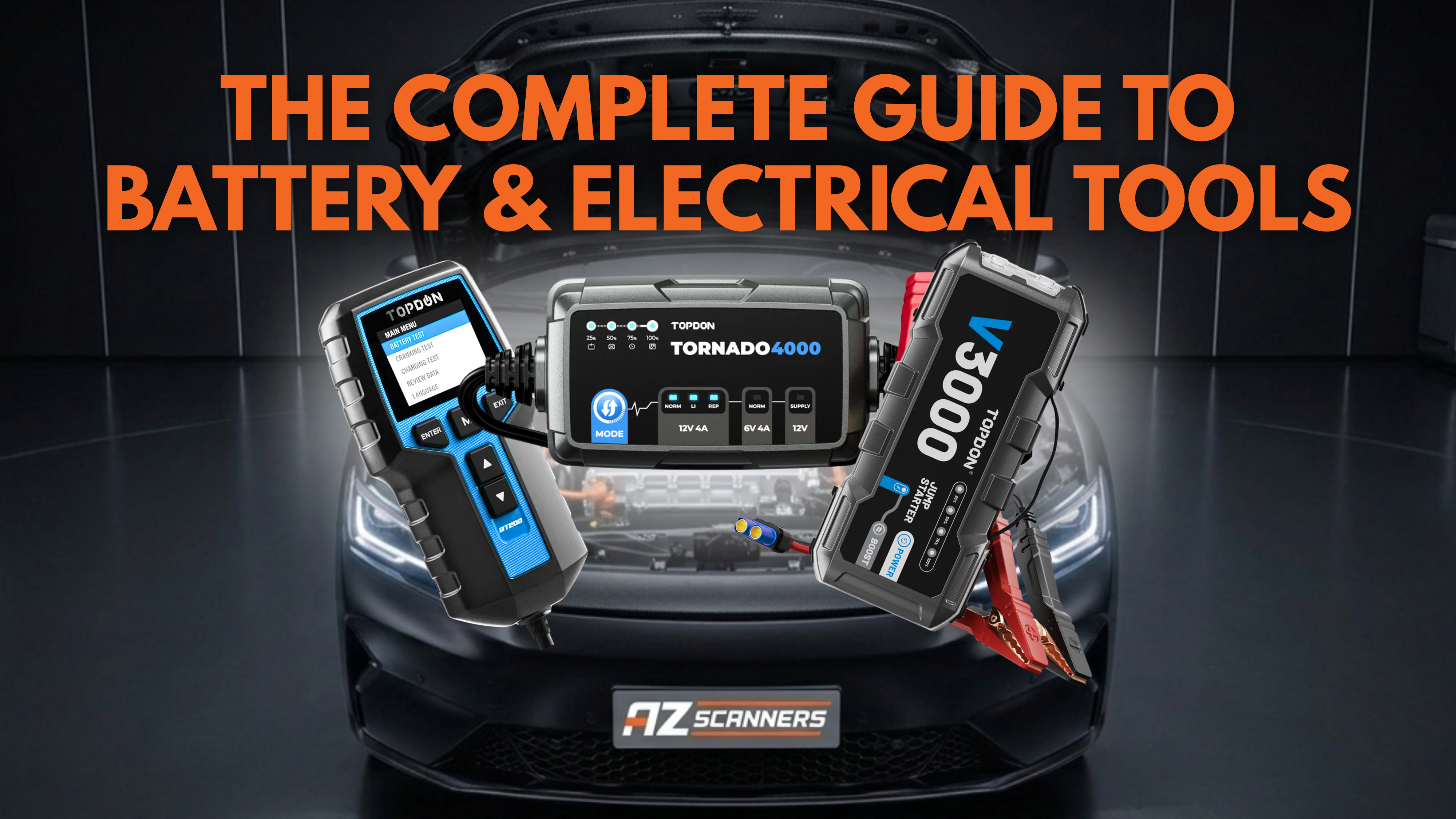
A flat or failing battery is one of the most common causes of vehicle breakdown in Australia — and in most cases, it's entirely preventable. Whether you're a daily driver, a 4WD enthusiast heading off-road, or a workshop professional looking after a fleet, having the right battery and electrical tools on hand can save you time, money and a roadside headache.
In this guide, we cover everything you need to know about the three essential battery tools: car battery testers, portable jump starters and smart battery chargers — what they do, how they differ, and how to choose the right one for your vehicle and situation.
Battery Testers, Jump Starters & Battery Chargers — What's the Difference?
These three tools are often confused, but they each serve a distinct purpose:
- A battery tester diagnoses the health of your battery and charging system — telling you whether your battery is still serviceable or needs replacing before it fails completely.
- A jump starter provides an instant burst of power to start a vehicle with a flat or dead battery — a roadside emergency tool that works without needing a second vehicle.
- A battery charger restores and maintains a battery's charge over time — the right tool for recovering a flat battery properly and keeping stored or infrequently used vehicles topped up.
Each solves a different problem. For most Australian drivers, a jump starter and battery tester together cover the majority of situations. Add a smart charger if you store vehicles, own a classic car, or want to maximise battery lifespan.
What Is a Car Battery Tester?
A car battery tester — also known as a battery load tester or automotive battery analyser — measures the condition of your vehicle's battery and electrical system without needing to remove or discharge the battery. Rather than simply telling you if a battery is charged, a quality battery tester gives you a detailed health picture, including cranking performance, cold cranking amps (CCA) and the condition of your alternator and charging system.
A weak battery rarely fails without warning. A battery tester lets you spot a declining battery weeks before it leaves you stranded — making it one of the most cost-effective diagnostic tools available.
Depending on the model, an automotive battery tester can perform:
- Battery test — measures state of health and capacity against rated CCA, returning a pass, warning or replace result
- Cranking test — measures voltage drop during engine cranking to assess whether the battery is delivering sufficient power to start the engine
- Charging test — checks alternator output while the engine is running to confirm it is charging correctly (should read 13.8–14.4V)
- System test — available on advanced models, checks the full 12V or 24V electrical system including ripple voltage and load performance
What Is CCA and Why Does It Matter?
CCA stands for Cold Cranking Amps — the measure of a battery's ability to start an engine in cold conditions. It represents how much current a battery can deliver for 30 seconds at -18°C while maintaining a voltage above 7.2V. All battery testers in our range support CCA testing across major international standards including CCA, CA, BCI, MCA, DIN, IEC, EN, SAE, JIS and GB — making them compatible with Australian, Japanese, European and American vehicles.
Choosing the Right Battery Tester
- For everyday drivers and home mechanics — the TOPDON BT100 and Vident iBT100 are simple, compact 12V battery testers covering battery, cranking and charging tests. Straightforward to use with no setup required.
- For mixed 12V and 24V vehicles — the TOPDON BT200 and Vident iBT200 both add 24V support, making them suitable for cars, utes, vans and light commercial vehicles.
- For workshops needing printed reports — the TOPDON BT300P includes a built-in thermal printer to produce instant battery test reports for customers — a professional touch that adds real credibility to your service.
- For full professional workshop use — the TOPDON BT600 and Autel MaxiBAS BT608 offer full system testing, built-in thermal printers and the widest battery type support. The go-to choice for busy independent workshops and dealerships.
What Is a Jump Starter?
A jump starter — also known as a jump starter pack, battery booster or portable battery pack — is a compact lithium-powered device that provides an instant surge of power to start a vehicle with a flat or dead battery. Unlike traditional jumper cables that require a second vehicle, a portable jump starter works independently, making it the ideal roadside emergency tool for any Australian driver.
Modern lithium jump starters are lightweight, fast-charging and capable of starting everything from small hatchbacks to large diesel utes. Many models also double as a USB power bank and feature built-in LED torches and air compressors — making them far more than just a jump starter.
The most important specification to look at is peak amps — the maximum burst of power the unit can deliver to start your engine. As a general guide:
- Up to 1200A — suitable for small to medium petrol cars and motorcycles. Compact and easy to store in a glovebox.
- 1500A–2200A — the sweet spot for most Australian cars, SUVs and 4WDs. Handles petrol engines up to 8.0L and diesel up to 6.0L.
- 3000A+ — for large diesel utes, trucks and commercial vehicles.
- 4500A — professional-grade heavy diesel. Handles engines up to 16.0L gas or diesel, ideal for trucks, buses and fleet vehicles.
Choosing the Right Jump Starter
- For everyday drivers wanting glovebox convenience — the TOPDON V1200Air combines a 1200A jump starter with a built-in tyre inflator in a compact, portable package. Perfect for everyday cars and small SUVs.
- For most Australian cars, SUVs and 4WDs — the TOPDON V2200Air delivers 2200A peak power with a built-in tyre inflator capable of inflating up to 150 PSI — our top recommendation for most drivers.
- For large diesel utes and workshop use — the TOPDON V3000 delivers 3000A peak power, rated to 7.0L diesel, with up to 45 jump starts per charge and PD60W fast charging.
- For trucks, buses and fleet vehicles — the TOPDON V4500 Plus handles engines up to 16.0L gas or diesel with a rugged IP-rated enclosure built for harsh environments.
What Is a Smart Battery Charger?
Unlike a basic charger that simply pushes current into a battery until it's full, a smart battery charger uses multi-stage charging technology to optimise the charge cycle, protect against overcharging and extend battery life. TOPDON's 9-step smart charging process includes diagnosis, desulfation, pre-charge, bulk charge, absorption, analysis, reconditioning and maintenance — giving your battery a thorough and safe charge every time.
Smart chargers are compatible with all common battery types including Wet, Gel, AGM, EFB, MF, CAL, VRLA and Lithium — making them suitable for modern cars, 4WDs, motorcycles, caravans, boats and commercial vehicles.
A common question is the difference between a battery charger and a trickle charger. A trickle charger delivers a slow, low-current charge to maintain a battery that isn't being regularly used. A smart battery charger does this and much more, automatically switching between charging modes as needed. All TOPDON chargers include a trickle/maintenance mode, so they function as both a full charger and trickle charger in one unit.
Choosing the Right Battery Charger
- For home use and trickle charging — the TOPDON Tornado4000 is our entry-level recommendation. Compact, easy to use, handles 6V and 12V batteries up to 120Ah. Perfect for keeping a daily driver, classic car or stored vehicle topped up.
- For home mechanics wanting charge and test in one unit — the TOPDON TB6000Pro adds a built-in battery tester and smartphone app connectivity, giving you a charging report alongside battery health status.
- For workshops needing faster charging — the TOPDON TB8000 delivers 8A output across 6V and 12V batteries up to 260Ah, with spark elimination technology and 6 charging modes. Ideal for independent mechanics and mobile services.
- For professional workshops doing ECU programming — the TOPDON Tornado90000 delivers up to 90A output across 12V and 24V with a dedicated voltage stabiliser for module coding and ECU programming. Supports batteries up to 2800Ah.
Quick Decision Guide
- Want to check battery health at home? → TOPDON BT100 or Vident iBT100
- Need a tester for 12V and 24V vehicles? → TOPDON BT200 or Vident iBT200
- Workshop needing printable battery reports? → TOPDON BT300P
- Everyday driver wanting roadside peace of mind? → TOPDON V1200Air
- Best jump starter for most Australian cars and 4WDs? → TOPDON V2200Air
- Jump starter for large diesel utes and workshops? → TOPDON V3000
- Home trickle charger for stored vehicles? → TOPDON Tornado4000
- Home charger with built-in battery tester? → TOPDON TB6000Pro
- Workshop charger for ECU programming? → TOPDON Tornado90000
Final Thoughts
Battery failures are one of the most preventable causes of vehicle breakdown in Australia. Whether you're after a simple home battery tester, a compact jump starter for the glovebox, or a professional smart charger for your workshop — having the right tool on hand saves time, money and the frustration of being caught out.
All products are stocked and supported by our Australian-based team, and we're happy to help confirm which option is the best fit for your vehicle or workshop before you buy.
*Please note: Battery compatibility and supported battery types can vary by model. We always recommend checking product specifications to confirm suitability for your specific battery type and capacity before purchasing.
→ Browse our full Battery & Electrical Equipment range online or reach out to our team on 03 8658 8894 for a recommendation tailored to your needs.
Frequently Asked Questions
What is the difference between a battery tester, a jump starter and a battery charger?
Each tool serves a different purpose. A battery tester diagnoses the health of your battery and charging system — telling you whether your battery is still serviceable or approaching failure. A jump starter provides an instant burst of power to start a vehicle with a flat or dead battery without needing a second vehicle. A battery charger restores and maintains a battery's charge over time, ideal for recovering a flat battery properly or keeping a stored vehicle topped up. For most drivers, a jump starter and battery tester together cover the majority of situations.
What is the best jump starter for a car in Australia?
For most Australian cars and SUVs, the TOPDON V2200Air is our top recommendation. It delivers 2200A peak power, handles petrol engines up to 8.0L and diesel up to 6.0L, and includes a built-in tyre inflator making it a complete roadside emergency kit. For a more compact option, the TOPDON V1200Air is a great entry-level choice. For large diesel utes, the V3000 rated to 7.0L diesel is the better fit.
Can a jump starter start a diesel vehicle?
Yes — all TOPDON jump starters in our range are rated for both petrol and diesel engines. Diesel engines generally require more cranking power than equivalent petrol engines. For large diesel utes, 4WDs and trucks we recommend the TOPDON V3000 (rated to 7.0L diesel) or V4500 Plus (rated to 16.0L diesel) for reliable starting every time.
What is the best car battery tester for home use in Australia?
For most home mechanics the TOPDON BT200 or Vident iBT200 are ideal — both cover 12V and 24V batteries, perform battery, cranking and charging tests, and have clear colour screens. If you only need basic 12V testing the TOPDON BT100 or Vident iBT100 are more compact and affordable. For workshops needing printable reports, the TOPDON BT300P with built-in thermal printer is the professional choice.
What is the difference between a battery charger and a trickle charger?
A trickle charger delivers a slow, low-current charge designed to maintain a battery at full capacity over a long period — ideal for stored vehicles, classic cars and caravans. A smart battery charger does this and much more, using multi-stage charging to optimise the charge cycle and protect battery health. All TOPDON chargers in our range include a trickle/maintenance mode, so they function as both a full smart charger and trickle charger in a single unit.
Are these battery chargers compatible with AGM, lithium and deep cycle batteries?
Yes — all TOPDON chargers in our range support multiple battery chemistries including Wet, AGM, Gel, EFB, MF, CAL, VRLA and Lithium. Always check the product specifications to confirm compatibility with your specific battery type and capacity before purchasing.
Can I use a battery charger for ECU programming?
Yes — but you need a charger specifically designed for this purpose. During ECU programming the vehicle's voltage must remain stable, otherwise the procedure can fail or damage the module. The TOPDON Tornado90000 includes a dedicated voltage stabiliser mode maintaining a consistent output of 11–15.8V (12V) or 22–31.6V (24V), making it the correct tool for any workshop performing coding, module replacement or key programming.
How long does it take to charge a car battery?
This depends on the charger output in amps, the battery capacity in Ah, and the current state of charge. As a rough guide, a flat 60Ah battery charged at 6A (TOPDON TB6000Pro) will take approximately 10 hours from empty to full. At 8A (TOPDON TB8000) the same battery charges in around 7–8 hours. Smart chargers automatically adjust the charge rate throughout the cycle to ensure a full, healthy charge.